It's Monday of our final week in Oxford. It's difficult to believe the program is nearly over. While we've been here for a while, we've kept ourselves very busy with class, homework, site visits, and travel. As anticipated, there hasn't really been enough time to do and see everything there is to do and see.
This morning started early. We met around 6.30 for our two-hour bus trip to Derby for the
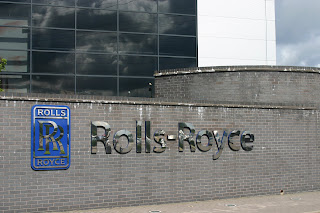
Rolls-Royce visit. Rolls-Royce is a world leader in providing integrated power systems for use on land, at sea, and in the air. In addition to their civil aerospace, defense aerospace and marine businesses, they have a growing business in the energy sector. Beyond their traditional manufacturing business, they are also growing as a service provider.
Rolls-Royce really provided an outstanding experience. We were met with a team of presenters who gave us an overview of the company as well as presentations on global supply chain and Human Resource considerations in a global environment. Before long we left the Learning and Career Development Center for the New Engine Assembly & Test Facility. Here we learned about the various large aircraft engines manufactured by Rolls-Royce, and then toured the plant floor where we saw a number of engines in production. The factory floor was a surprisingly clean and flexible space, where they produce about six engines per week, although they are considering strategic ways to shorten the production time for a single engine. Before leaving the assembly area, we learned a little about engine testing and certification standards.
Our next stop was the HP Blade Facility, where Rolls-Royce manufactures 16 types of turbine blades for their aircraft engines. In contrast to the assembly plant, this fairly new facility was noisy and highly automated. The blades are crafted with incredible precision. They are infused with patterns of microscopic holes which help the blades withstand engine temperatures of 1700 degrees Centigrade. Placement of the holes is checked with a precise magnifying camera. Each blade is inscribed with a tiny, three-dimensional dot matrix code which identifies not only the part and its date and time of manufacture, but also information about the machine operators and their work schedule.
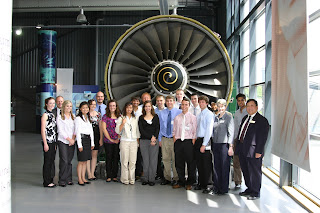
After leaving the Blade Facility, we returned to the Learning and Career Development Center, where we enjoyed a lunch at the Rolls-Royce Heritage Center. Everyone enjoyed seeing some of the engines manufactured by Rolls-Royce during the past 100 years and reading about the company's many achievements. We were able to take some group photos before leaving the Rolls-Royce campus.
Next we drove through downtown Derby to take a quick look at the birthplace of the Industrial Revolution before heading to nearby
Donington Park. At Donington Park, we were given a private guided tour of the Grand Prix Exhibition, which is the largest collection of Grand Prix racing cars in the world. Our guide, a professional driver and racing instructor, was quite knowledgeable of the facility, cars, and drivers. The museum included more than we could possibly take in during one visit. And to make us feel more at home, there were several Indy cars within the collection.

We made it back to St. Catz about 11.5 hours after we started, and we were a tired group. But it wasn't time to relax: tomorrow is exam two, and the following day is the group presentations. It's crunch time!


 The Tower also has an elaborate display of armor worn by many past kings, including some especially notable individuals such as Henry VIII. There are also buildings where high profile prisoners were held in the tower. In one tower the prisoners created intricate "graffiti" which was actually a series of detailed stone carvings. These were created mainly during the 1500s and are all still preserved today.
 The rest of the late afternoon and evening students were free to stay in London and explore on their own. Some stayed late and others headed back to Oxford early since now our days here are few.
  On my wait to the restroom, I discovered the secret to these delicious chips - heaps of bags of real potatoes. This place did it the old fashioned way and cut, soaked and fried the potatoes themselves with nothing frozen! I couldn't resist including the picture of the potato bags below and of course in true English style there was a pair of Wellington boots right in the bottom left of the picture.
 We had a tremendous guide who offered all sorts of wonderful information and even tailored the tour for our students. She wove in great information on how the palace functions as a business and talked about the financial, marketing and logistical operations of the site. Unfortunately pictures weren't allowed inside the palace, but it was truly amazing. It still functions as a residence and currently, Sir John George Vanderbilt Spencer-Churchill, the 11th Duke of Marlborough lives in the palace. Yes, the names are all those you're familiar with. Vanderbilt as in the American Vanderbilts who are connected to the lineage by marriage, Spencer as in those related to the late Princess Diana and of course Churchill. We were told the Duke, referred to as His Grace, was in the day we visited. The two signs were the flag flying over the palace and his black Range Rover parked out front. His is the only vehicle allowed inside the palace grounds. Because it still functions in part as a residence, the palace all felt very alive. The rooms were all still fully furnished and artwork and artifacts were abundant. After the tour, the rain cleared and the group enjoyed the grounds on their own before heading back to Oxford.


 After the Clarks visit the group went on to Clarks Village where they had about an hour to eat lunch and do any shopping they could fit in. Some people managed to do well on both accounts! After this quick stop, we drove about an hour to Stonehenge.
 Stonehenge offered a free audio guided tour and great photo opportunities for the group. Despite a forecast of rain, we enjoyed a dry visit.
 After this visit we moved on to our final stop, the city of Bath. The city was beautiful and offered plenty of opportunity for exploration. At 8pm we had reservations to tour the Roman Baths. This visit was absolutely stunning. Parts of the Roman Baths and the associated temple date back as early as 60-70AD. Over the past 2000 years various civilizations have added, modified and restored the Baths. What results today is a breathtaking museum that allows visitors to experience history firsthand. The location was chosen for the natural hot springs that offer up water at about 115 degrees at a rate of 1.17 million liters per day. The hot springs are still functional, but the Roman Baths are not considered safe for bathing. However, the city has constructed two modern style baths to allow bathers to experience the hot springs spa experience.

 This weekend students will work on group projects, explore Oxford and travel as they choose.


